Where Most People's Money Ends Up
For most people, the first investment account they ever open isn't chosen so much as it's handed to them. A visit to a bank for a chequing account turns into a conversation about RRSPs or TFSAs, and within twenty minutes, money starts flowing into a mutual fund — often one managed in-house by the bank itself.

This isn't a conspiracy; it's simply the path of least resistance. Banks are built to make this the easy option: the advisor is already there, the paperwork is already familiar, and the fund lineup is already curated. For someone who isn't looking to become a hands-on investor, that convenience is real and valid.
What often goes unexamined is where the money sits once it arrives. Bank-managed mutual funds pool money from thousands of investors and are actively managed by a professional (or team) who selects the underlying holdings. That active management is the product being sold — and it comes with an ongoing fee, built into the fund itself, called the Management Expense Ratio (MER).
The MER isn't a one-time charge. It's deducted continuously, a little at a time, directly from the fund's returns — which means it's rarely seen as a line item on a statement. Most investors could tell you their fund's rate of return. Far fewer could tell you its MER.
That's the starting point worth understanding: A large share of everyday retirement and investment savings in Canada sits inside actively managed mutual funds, purchased through the default channel of a bank, carrying a fee that's easy to overlook because it's never billed directly.
What That Fee Costs Over Time
What That Fee Costs Over Time
A typical Canadian bank mutual fund carries an MER somewhere in the range of 1.5% to 2.5% per year. A self-directed portfolio of broad-market index ETFs, by contrast, often carries a fee closer to 0.05% to 0.25%. On paper, that gap looks small. Over decades, it compounds into something much larger.
Consider $50,000 invested for 30 years, growing at an assumed 7% average annual return before fees:
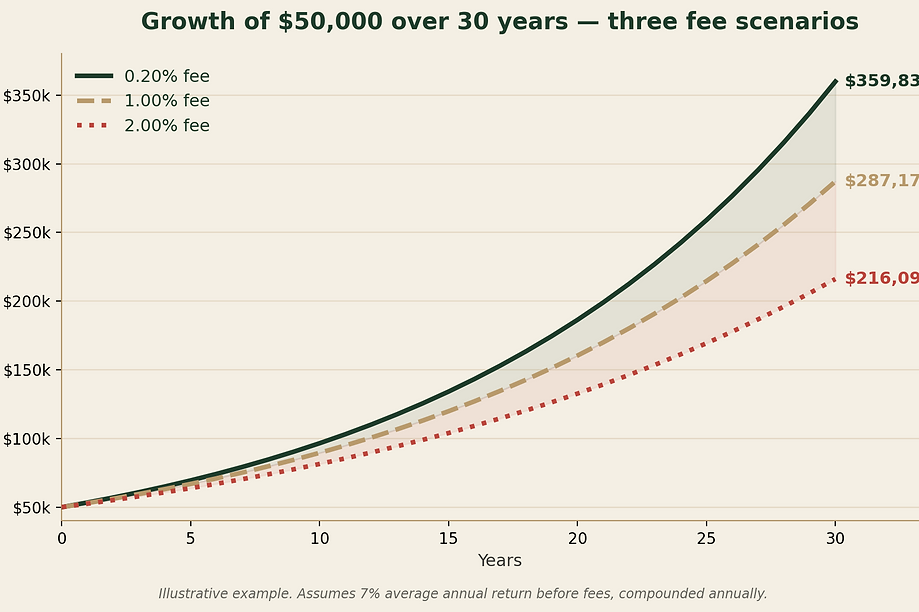
The gap isn't caused by one fund performing worse than another in a given year. It's caused by the fee being subtracted every single year, which means the portion of your money lost to fees also loses the chance to grow. A dollar paid in fees in year one isn't just a dollar — it's every year of compounding that dollar would have produced.
This is the core mechanic worth sitting with: fees are often described in small percentages, but their impact is measured in decades of missed compounding, not single-year performance. Whether a higher-fee, actively managed fund or a lower-fee, self-directed approach is the better fit depends on an individual's goals, involvement level, and comfort with managing their own portfolio — that's a separate question. But understanding the size of the gap is the first step to asking it.