Stop Tinkering With Your Portfolio: Let Simplicity Work for You

Build a portfolio you can live with—and then give it time to work.
One of the hardest parts of investing isn't choosing an ETF. It is leaving it alone.
Once you become a self-directed investor, there is an almost endless supply of information telling you what you should be doing with your money. Markets are going up or down. Interest rates are changing. One country is outperforming another. Technology stocks are soaring. A recession may be coming. A new investment is suddenly being described as "the next big thing."
And because your brokerage account is only a few clicks away, acting on that information is remarkably easy.
But here's an important question:
Does constantly changing your portfolio actually make you a better investor?
Often, it can do the opposite.
For many investors, a simple portfolio consisting of one, two or three broadly diversified ETFs can provide a solid foundation for long-term investing. Once the portfolio has been designed around the investor's goals, time horizon and tolerance for risk, there may be surprisingly little that needs to be changed.
The challenge becomes resisting the temptation to interfere.
Investing doesn't have to be complicated
There is a common assumption that a sophisticated portfolio must contain a large number of investments.
It doesn't.
A broadly diversified ETF can already own hundreds or even thousands of securities. Depending on the ETF, that could mean exposure to companies across numerous industries and countries, rather than relying on the fortunes of a handful of individual stocks.
The U.S. Securities and Exchange Commission's Investor.gov explains that diversification involves spreading investments across asset classes and within those asset classes. It also notes that ETFs can make diversification easier because a single fund can provide exposure to many underlying investments.
That is one of the great advantages of ETFs.
Instead of trying to assemble dozens of individual investments yourself, you can use a small number of broadly diversified funds to create the core of your portfolio.
The result can be considerably easier to understand—and considerably easier to maintain.
The problem with constant tinkering
Imagine you have built a portfolio that matches your objectives.
Then the stock market falls 10%.
You become concerned.
You read that a recession could be coming, so you reduce your stock allocation.
A few months later, the market rebounds sharply.
Now you feel that you missed the recovery.
Technology stocks are doing particularly well, so you decide to add a technology ETF.
Then international stocks begin outperforming the United States.
You add another fund.
Before long, your original simple portfolio has become a collection of investments based on a series of decisions made at different points in time.
None of those decisions necessarily seemed unreasonable when you made them.
That's the problem.
Tinkering rarely feels like tinkering when you're doing it. It feels like making a sensible adjustment.
The difficulty is that markets don't provide us with enough information to know whether today's adjustment will turn out to be a good decision tomorrow.
Your emotions are part of the equation
Investing is often described as a numbers game.
But investors are human.
When markets rise, optimism can make us believe that the good times will continue.
When markets fall, fear can make us believe that things will get worse.
When a particular investment is performing exceptionally well, we may feel that we should own more of it.
And when something has performed poorly, we may want to get rid of it just when it has become relatively inexpensive.
This is why investor behavior matters so much.
Vanguard has written extensively about the relationship between emotions and investment decisions, emphasizing the importance of maintaining perspective and discipline rather than allowing short-term market developments to dictate long-term decisions.
The lesson isn't that investors should somehow eliminate emotion.
That's unrealistic.
The better approach is to build an investment process that reduces the number of emotional decisions you have to make.
A simple portfolio can help do exactly that.
Don't try to predict which market will win next
There will always be a reason to change your portfolio.
Canada may be doing poorly.
The United States may be expensive.
Emerging markets may look attractive.
Technology may appear unstoppable.
Bonds may have disappointing returns.
The temptation is to move money toward whatever looks most promising at the moment.
But the market has a way of making yesterday's obvious winner look much less obvious in hindsight.
You don't have to predict which country, sector or investment will perform best next year if your portfolio already owns a broad range of them.
Diversification replaces prediction.
Rather than trying to identify tomorrow's winner, you own a collection of investments and allow the market to determine which ones perform best.
That doesn't guarantee good returns or eliminate losses. Diversification cannot protect you from a broad market decline. But it can reduce the risk of having your financial future depend too heavily on one investment, sector or region.
One ETF can be enough
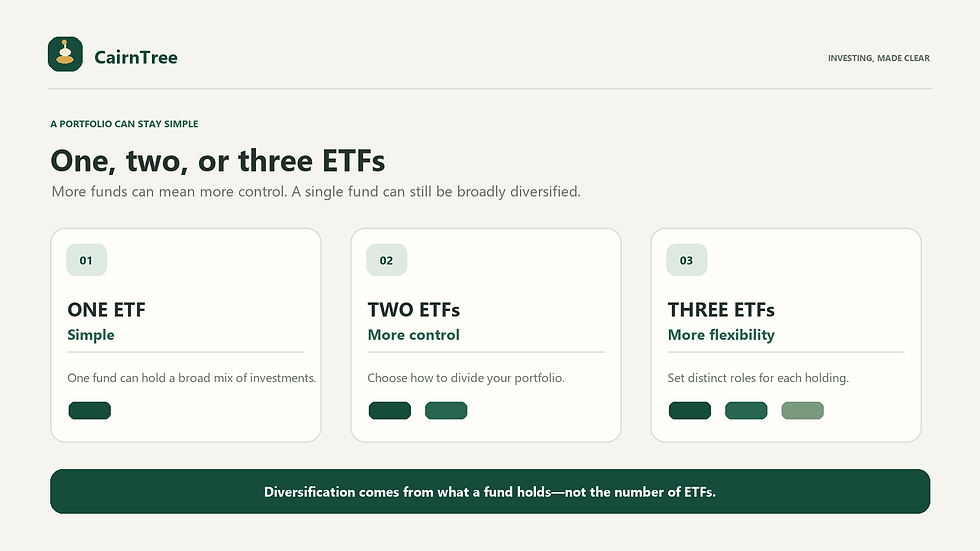
For some investors, a single asset-allocation ETF may provide almost everything they need.
Such a fund can combine stocks and bonds in a predetermined mix and maintain that allocation within the fund.
The investor's job can therefore be remarkably simple:
Buy it. Continue investing. And leave it alone.
This isn't appropriate for everyone.
Some investors want more control over their asset allocation. Others may have tax considerations, income requirements or account-specific circumstances that make a multi-ETF approach preferable.
That's where a two- or three-ETF portfolio can make sense.
For example, an investor might choose separate ETFs to control the mix of:
Canadian equities
U.S. and international equities
Bonds
The important point isn't the number of ETFs.
The important point is that each investment has a purpose.
If you can't explain why you own an ETF and what role it plays in your portfolio, it may be worth asking whether you need it.
Simple doesn't mean careless
There is an important difference between simplicity and neglect.
A simple portfolio should still be reviewed.
Your circumstances can change. Your retirement date can change. Your income needs can change. Your tolerance for risk can change.
And your portfolio can drift away from its intended allocation as different investments produce different returns.
That's where rebalancing comes in.
Rebalancing isn't about predicting the market. It is about bringing your portfolio back toward the asset allocation you originally decided was appropriate.
Investor.gov describes rebalancing as bringing a portfolio back toward its original asset allocation after different investments have grown at different rates.
Vanguard likewise emphasizes that rebalancing is a way of managing risk and maintaining the intended portfolio rather than attempting to time the market.
So the goal isn't:
"Never touch your portfolio."
The goal is:
"Don't touch it without a good reason."
Review your plan—not the headlines
There is a useful distinction between reviewing and reacting.
A review asks:
Is my portfolio still appropriate for my goals?
Has my time horizon changed?
Has my tolerance for risk changed?
Has my financial situation changed?
Has my asset allocation drifted significantly?
Are my investments still providing the diversification I intended?
Are my costs reasonable?
Reacting sounds different:
"The market is falling, so I should sell."
"Technology has gone up so much that I should buy more."
"Bonds haven't performed well, so I don't need them."
"Canada is lagging, so I'm going to move more money into the U.S."
"Everyone is talking about this ETF, so I should own it."
The first approach is plan-driven investing.
The second is often headline-driven investing.
You don't need to check your portfolio every day
The ability to see your portfolio at any moment can be useful.
But it can also be a distraction.
If you are investing for a decade, two decades or longer, what happened to your portfolio yesterday is unlikely to determine whether you achieve your long-term objective.
Vanguard specifically recommends keeping investment performance in perspective, noting that while monitoring performance is reasonable, investors shouldn't allow short-term results to distract them from their long-term goals.
This is particularly relevant for self-directed investors.
When you are responsible for your own portfolio, there is nobody standing between you and the "Buy" or "Sell" button.
That freedom is valuable.
But so is the discipline not to use it unnecessarily.
Time is an important part of the strategy

A simple portfolio isn't designed to win every month or every year.
There will be periods when stocks perform poorly.
There will be periods when bonds struggle.
There will be periods when one country or region significantly outperforms another.
That's normal.
The purpose of a long-term portfolio is to participate in the growth of markets over time while managing the level of risk you are willing and able to accept.
Compounding also needs time.
Vanguard describes compounding as the process by which investment earnings themselves can generate additional earnings. Importantly, compounding doesn't require successfully predicting short-term market movements; it benefits from remaining invested and allowing time to work.
Every time you make a major change to your portfolio, you are making another prediction.
Sometimes that prediction will be right.
Sometimes it won't.
A disciplined long-term strategy reduces the number of predictions you need to make.
A boring portfolio can be a successful portfolio
Investing is often presented as something that should be exciting.
New ETFs.
New technologies.
New market trends.
New forecasts.
New opportunities.
But your retirement portfolio doesn't need to be exciting.
In fact, boring can be a very good thing.
If your portfolio is diversified, appropriately allocated, low-cost and easy to understand, you don't need it to give you something new to think about every week.
You need it to keep doing its job.
That job is to help you build and preserve wealth over the long term.
Give your portfolio a chance to work
There is no guarantee that a simple portfolio will outperform a more complicated one.
There is also no guarantee that staying invested will prevent losses.
But complexity doesn't automatically create better results.
Sometimes it simply creates more decisions.
And more decisions create more opportunities to react to fear, excitement, headlines and short-term performance.
That's why a simple portfolio can be so powerful.
You make the important decisions up front.
You decide how much risk you are willing to take.
You decide how broadly you want to diversify.
You choose investments that fit the plan.
You keep costs under control.
Then you let the portfolio do its job.
The next time you want to make a change...
Before buying another ETF or selling an existing one, stop and ask yourself:
"Has something fundamental changed—or am I simply reacting to what the market has done?"
If your goals haven't changed, your circumstances haven't changed and your investment plan is still appropriate, there may be no reason to act.
Sometimes the smartest thing you can do with your portfolio is nothing.
Not because you don't care about your investments.
Because you have already done the work.
Build a sensible portfolio.
Keep it diversified.
Keep it simple.
Review it periodically.
Rebalance when necessary.
And then give time and compounding the opportunity to do their part.
The CairnTree takeaway
You don't need to constantly improve your portfolio. You need a portfolio you can stick with.
A one-, two- or three-ETF portfolio isn't necessarily better because it has fewer investments.
It can be better because it makes your investment strategy easier to understand—and easier to follow when markets become difficult.
In investing, doing more isn't always doing better.
Sometimes, staying the course is the strategy.
Sources and further reading
Vanguard — The Science Behind Money and Emotion
Vanguard — Four Timeless Principles for Investing Success
Vanguard — Keeping Investment Performance in Perspective
Vanguard — Rebalancing Your Portfolio
U.S. Securities and Exchange Commission / Investor.gov — Asset Allocation and Diversification
This article is provided for educational purposes only and is not personalized investment advice. All investments involve risk, including the potential loss of principal. The appropriate portfolio and asset allocation depend on an individual's objectives, financial circumstances, time horizon and tolerance for risk. Past performance is not a guarantee of future results.
Comments