ONGOING PORTFOLIO MANAGEMENT
Managing the urge to act
A portfolio can be built well and still feel like it needs fixing every time the market moves. That feeling is normal — it's also usually not information.
How Compounding Works Over Time
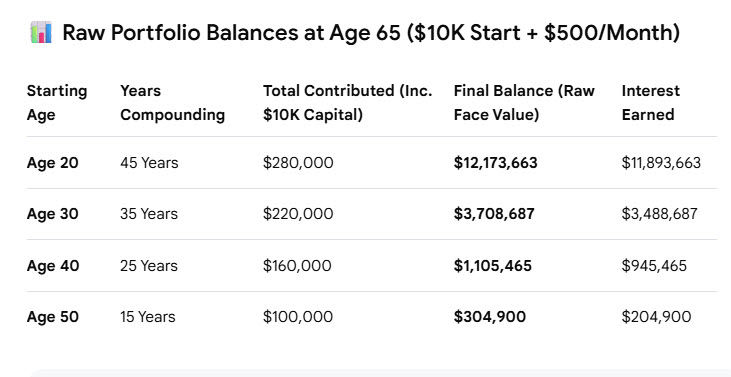
If you look strictly at the raw (nominal) numbers without adjusting for inflation, starting at age 20 with a $10,000 initial capital and a flat $500 monthly contribution yields a final balance of $12,173,663 at age 65.
These calculations use the 11.85% nominal total annual return, (the unadjusted face-value performance of the S&P 500 over the last 50 years. 8.97% index change and 2.88% dividends). Because there is no inflation adjustment applied here, your monthly contribution stays exactly $500 per month from the day you start until the day you turn 65.
The take away:- Just keep adding to your nest egg, keep your head down and just don't tinker with it.
Where the pull to tinker comes from
A few well-documented tendencies show up almost universally once real money is on the line. A loss tends to feel more painful than an equivalent gain feels good, so a dip pulls harder at attention than a rally does. A recent stretch of movement — up or down — tends to feel like it will keep going, even when it's ordinary short-term noise. And doing something, almost anything, tends to feel more like managing a portfolio than doing nothing does, even in moments where nothing is the better move.
These patterns have names in behavioral finance — loss aversion, recency bias, and action bias among them.
What frequent checking adds
Checking a portfolio more often doesn't change what's actually happening inside it — it just increases the number of moments where a normal, short-term dip is visible. A portfolio checked daily will look like it's “in trouble” far more often than the same portfolio checked twice a year, even though the underlying holdings and the long-run outcome haven't changed at all.

This pull doesn't disappear just because there's only one holding to look at. For someone holding a single multi-asset ETF, the urge tends to show up differently — not as an urge to shift the mix between funds, since there's nothing to shift, but as an urge to add something next to it: a stock that's been in the news, a fund that's outperformed it recently, or a second ETF that looked better in a screenshot. The instinct is the same one described above; it's just aimed at growing the portfolio's complexity instead of adjusting the one holding already there.
Noise vs. signal
One way to sort a given moment: a market move on its own is usually noise. A change in personal circumstances — a job loss, a major expense, a shift in when the money will be needed — is usually signal. Separating the two is what a scheduled review is for; it's also most of what makes the gap between reviews easy to sit through.
This pull doesn't go away once money starts coming out of a portfolio instead of going in — if anything, it can get louder. The next article looks at what changes, and what doesn't, once withdrawals are part of the picture.