ONGOING PORTFOLIO MANAGEMENT
Asset allocation and asset location
Two decisions that sound like one — but only one of them changes once there's more than one account.
Two questions, one term
When people talk about “how their portfolio is set up,” they're often really asking two separate questions at the same time. The first is about the whole portfolio: what mix of stocks, bonds, and cash makes sense given how long the money has until it's needed and how much short-term movement feels tolerable. The second is about placement: given that mix, which specific account — a TFSA, an RRSP, a margin account, a Roth IRA — ends up holding which piece of it.
Both get filed under “portfolio structure,” which is part of why they get blurred together. They behave differently enough that it's worth separating them before going further.

Asset allocation: the overall mix
Asset allocation is the split between growth-oriented holdings (stocks and equity ETFs) and stability-oriented holdings (bonds and cash equivalents), considered across the entire portfolio — not account by account. An investor holding a stock ETF in one account and a bond ETF in another has, taken together, a mixed portfolio, even though neither account looks balanced on its own.
This is also the part of the decision that account count doesn't change. An investor with a single cash account and an investor with accounts spread across two countries are answering the exact same underlying question: what should the whole pie look like. How many accounts exist only affects the next decision — location — not this one.
Two things commonly move that mix over time: time horizon (how many years until the money is expected to be drawn on) and how an investor tends to react when a portfolio's value drops. Longer horizons and more tolerance for short-term drops tend to correspond to a larger equity share; shorter horizons and less tolerance for drops tend to correspond to more bonds and cash. Neither of those is something a general-education page can answer for a specific reader — they're personal, and they shift over time.
Why it's easy to miss
It's tempting to look at each account on its own and try to make every single one individually “balanced.” Self-directed investors sometimes end up holding a bit of everything in every account, which usually just adds complexity without changing the overall mix. The allocation question gets answered once, for the whole portfolio — the location question, covered further down, is what actually varies account to account.
How that mix tends to shift over the years
Self-directed investors' allocations generally aren't fixed for life. A portfolio built decades before any withdrawals are expected can tolerate more short-term movement than one that will be drawn down soon, so many investors gradually add bond exposure over time rather than holding one static mix indefinitely. This gradual shift is sometimes called a “glide path” — a slow adjustment over years, not a switch flipped on a particular birthday.
The table below illustrates one common pattern. It isn't a target or a recommendation for any specific age — the actual mix at any life stage depends on the individual's own time horizon and comfort with volatility, which this table can't know.

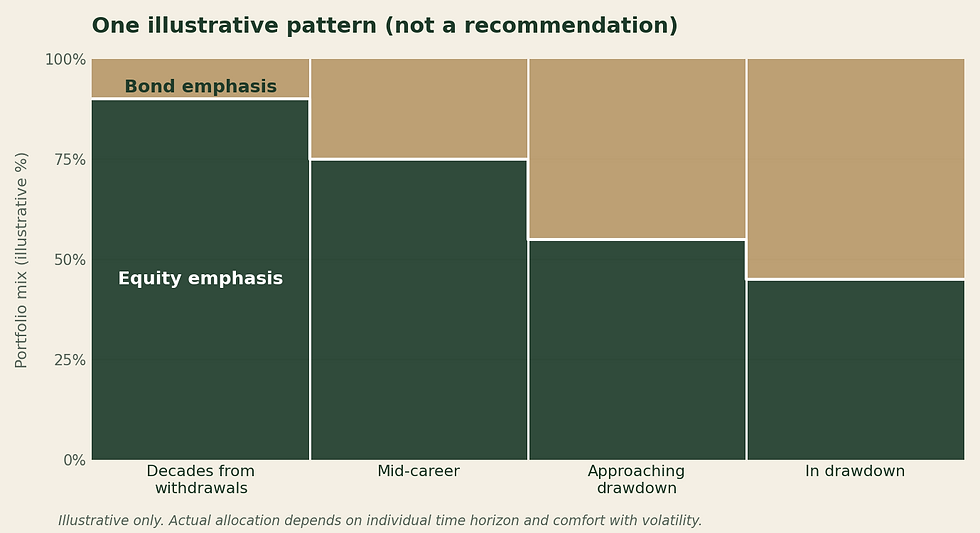
None of this — ie. the mix itself, or how it shifts over the years — depends on how many accounts an investor holds. Someone with a single cash account has, at this point, already answered the whole allocation question.
What changes once a second account enters the picture is where each piece of that mix actually sits. That's asset location, and it's a separate decision from here on.
Asset location: which account holds what
Once a portfolio spans more than one account, a further question opens up: given the target mix, which holdings go in which account? This only becomes relevant once there's a choice to make — an investor with a single account has nowhere else to put anything, so this section starts to matter as soon as a second account, of any type, is added.
The general placement principle is shared across Canada and the U.S.: holdings that generate more taxable income in a given year — interest-bearing bonds, REITs, holdings with frequent turnover — are generally more efficient sitting inside a tax-sheltered account. Holdings that are already comparatively tax-efficient in a taxable account — broad-market equity ETFs held long-term, which are typically taxed favourably on realized gains — tend to tolerate a taxable account better. This is a placement principle, not a fixed rule, and the specific mechanics behind it differ meaningfully between the two countries.
Where the account types line up
At a high level, Canadian and U.S. account types map onto similar roles, even though the rules underneath each one are different.
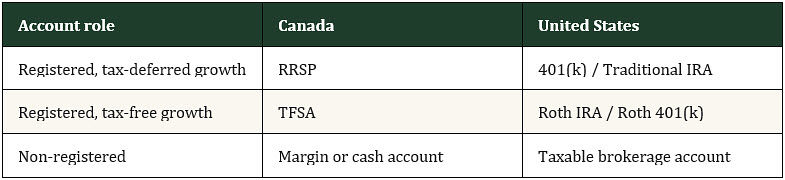
PLEASE NOTE:— contribution limits, foreign-withholding-tax treatment, and specific account rules change periodically and vary by provider.
Where this gets country-specific
The placement principle above holds in both countries, but the mechanics diverge quickly from there. Foreign-withholding tax on U.S. dividends is treated differently inside an RRSP than inside a TFSA. Traditional versus Roth account sequencing changes the location math in the U.S. Contribution-room rules on both sides affect how much flexibility there actually is to move things around. Rather than compress both countries' mechanics into one pass, the details live on their own pages:
Investors holding both CAD- and USD-denominated accounts add one more layer on top of this — currency exposure alongside asset type. That's covered on its own further down the path, under currency and cross-border considerations, rather than folded in here.